

Summary: This article covers practical dishwasher maintenance, including daily and weekly cleaning habits, how to clean the filter, spray arms, and door seals, and when to use vinegar or dishwasher cleaning tablets for a deeper clean. It also explains how to choose the right dishwasher detergent, how to eliminate odours, and how to troubleshoot common issues like poor cleaning, drainage problems, and strange noises. The article closes with guidance on when professional repair or installation services make sense.
How to Maintain and Clean Your Dishwasher
How to Clean Dishwasher | Dishwasher Installation | Dishwasher Detergent
Your dishwasher functions great every single day; however, somewhere along the way people tend to forget about the necessity of maintaining their dishwasher. Failing to maintain your dishwasher will lead to the formation of food particles in the filter, grease in the spray arms, and mineralisation of seals. The consequence of such maintenance will be an unpleasant odour and dirty dishes, as well as issues with draining, which will lead to water collecting inside the dishwasher. However, all of these problems can easily be prevented. This guide will provide you with information about dishwasher maintenance daily and weekly, how to clean it, how to pick up the right detergent, how to solve possible problems, and when to call the professionals.
Quick Answer: Ensure that you clean the filter of the dishwasher every week, clean the door gasket after every wash, and do a deep cleanse using vinegar or a cleansing tablet every month. The most frequent problems, such as foul smells, ineffective washing, or draining problems, occur due to the accumulation of food particles, fats, and mineral deposits.
Importance of Maintaining Dishwashers

A dishwasher is one of the most frequently used household appliances, so it needs regular maintenance to work efficiently. Over time, use causes dirt, grease, and other minerals to build up, which clogs filters, creates a dirty smell, and makes the cleaning process less effective. Failure to do maintenance of the device will mean that you will incur very high costs of repair or even have to buy a new one. Using effective maintenance techniques like cleaning of filters and appropriate cleaning agents, dishes will always be clean.
How to Maintain Your Dishwasher
Maintenance of your dishwasher is quite simple and easy. In order to do that, you would simply need to adopt certain practices to ensure that your dishwasher is not filled with any problems like blockages, build-ups, and bad odour. Some of these methods include cleaning the filter, inspecting the door gaskets and the spray arms and using proper detergent.
Daily Dishwasher Maintenance Tips
Clear out any food particles left on the dishes after every wash, even though the dishwasher is supposed to handle this task. Wipe the door seal and surrounding area with a wet rag to remove food particles and moisture and prevent odours from developing.
Weekly Dishwasher Maintenance
Doing the check of your dishwasher regularly allows you to avoid certain smaller problems developing into major ones:
- See if there is any food residue in the dishwasher, both at the bottom of the dishwasher and in its draining system.
- See whether there are no clogs in the holes of the spray arms since even a small clog may affect the process of washing.
In addition, check the filter since the reason why your dishwasher cannot clean properly is usually that the filter is clogged.
How to Clean a Dishwasher Step by Step
| Step | Task | Tip |
| 1 | Take out the lower tray. | Access filter and drain compartment |
| 2 | Rinse off the filter. | Turn, pull, and scrub with a soft brush. |
| 3 | Clean the inside and door. | Pay particular attention to the rubber seal. |
| 4 | Cleaning spray arm holes | Utilise a toothpick or a wire. |
| 5 | Do an empty hot wash. | Add a dishwasher cleaner. |
Cleaning the Dishwasher Filter
Inspect the dishwasher filter once a week, or twice a week depending on usage, since it captures food bits and stops them from ending up back on your dishes. Then clean the filter with warm water and use a soft brush to remove any remaining food bits
Unclogging the Spray Arms
Water is distributed via spray arms while washing, and that’s why it is very crucial to unclog the nozzle so as to ensure good washing. The spray arms can be removed if your washing machine allows you to do so; then you can wash it under water, unblock it using a toothpick and fix it back again with ease of motion.
Cleaning the Door Seals and Gasket
There is moisture in the door seals, and there are also food residues, hence making them more prone to mould growth and also to the bad smell. Cleaning of the door seals by use of a cloth slightly wetted with detergent will help to clean up these parts. It is very important to ensure that these parts are dried after cleaning.
Deep Cleaning Your Dishwasher
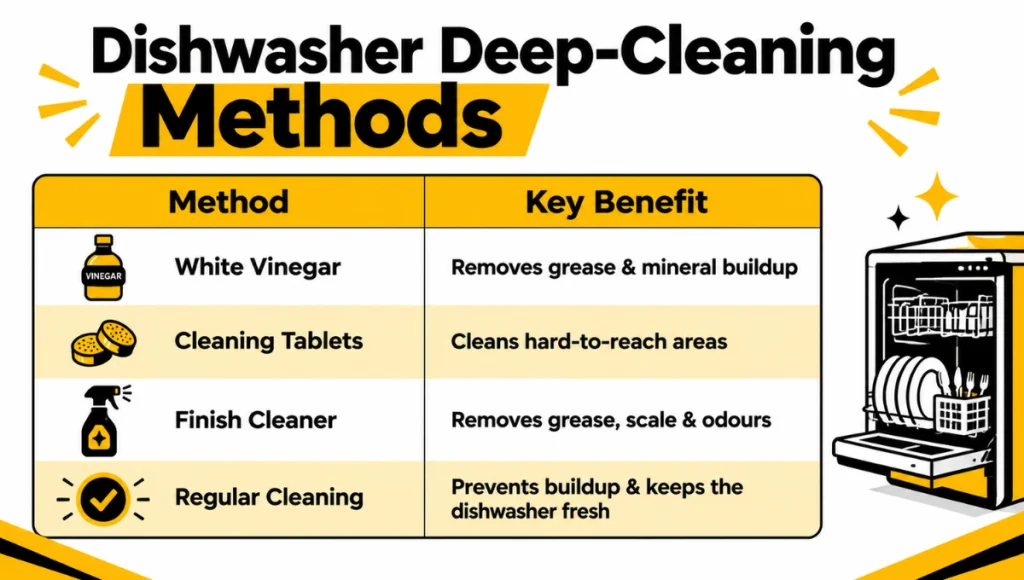
Even though it may have become part of your routine to keep cleaning the machine regularly,
Once or twice every month, it is important that you keep the machine well-maintained in an effort to ensure that there are no accumulations within the machine. As time passes, you would find that there are many different things that accumulate in the machine, like grease, food particles, minerals, and so forth. To get an overview of how you can maintain all your kitchen appliances, take a look at our guide to kitchen appliance maintenance.
How Do You Clean a Dishwasher with Vinegar?
Another common method used to clean your dishwasher is to make use of white vinegar. To clean your dishwasher using white vinegar, place one cup of white vinegar in a dishwasher-safe bowl placed on the top rack of your dishwasher and run a cycle with hot water. The white vinegar is an excellent cleaning agent that will help you remove the mineral deposits and greases. However, you need to make sure that you read the instruction manual from the manufacturer of your dishwasher and never mix vinegar with any detergent or bleach.
Dishwasher Cleaning Tablets
These dishwasher cleaning tablets will help in cleaning off the grease and minerals that can accumulate in places which cannot be cleaned manually.
- Helps in dissolving grease and mineral deposits.
- These help in cleaning places that cannot be accessed.
- These are a convenient way to clean your dishwasher.
Ensure you follow the directions given by the manufacturer while using them.
Finish Dishwasher Cleaner
Here is an example of a cleaning solution that is easily available in commercial outlets to remove the grease, scale, and odour from the washing tray, filter chamber, and the pipes. Like all other cleaning solutions, you should use these according to the manufacturer’s directions regarding frequency and amount. You can use cleaning solutions effectively alongside your regular maintenance routine.
Selection of the Proper Dishwasher Detergent
Dishwasher Detergent
Choosing the proper dishwashing powder is very significant for two reasons – not only due to the effect that the detergent will have on the efficiency of cleaning, but also because you will be using this detergent in your machine. It is specifically designed for achieving the optimal results with the use of water pressure and heating systems of your machine and will produce no excessive foam.
Dishwasher Soap VS Dishwasher Detergent
It would be interesting to know the differences between these two detergents, which can often be mistaken for normal hand dish soap.
| Category | Dishwasher Soap/Detergent | Regular Hand Dish Soap |
| Suds Level | Low foaming formulation, designed for machines | Sudsing, meant for manual cleaning |
| Safe for Dishwashers | Yes | No – may result in overflow or leakages |
| Cleaning Method | Uses pressure from water and heat cycles | Dependent on hand scrubbing |
| Best Use | Within the dishwasher | Dishwashing in the traditional way |
How to Get Rid of a Smelly Dishwasher
The bad odour coming from the dishwasher is as a result of the dirt that is present in the dishwasher. The type of dirt includes:
- Food that is stuck inside the dishwasher
- dirty grease in the dishwasher
- Dirty water in the filter of the dishwasher
In these scenarios, bacteria are able to thrive, leading to the smell. In solving the problem of this odour, one is supposed to begin by cleaning the filter, which is the source of the smell. Cleaning of the door seals and basin should be done.
Common Dishwasher Issues and Solutions
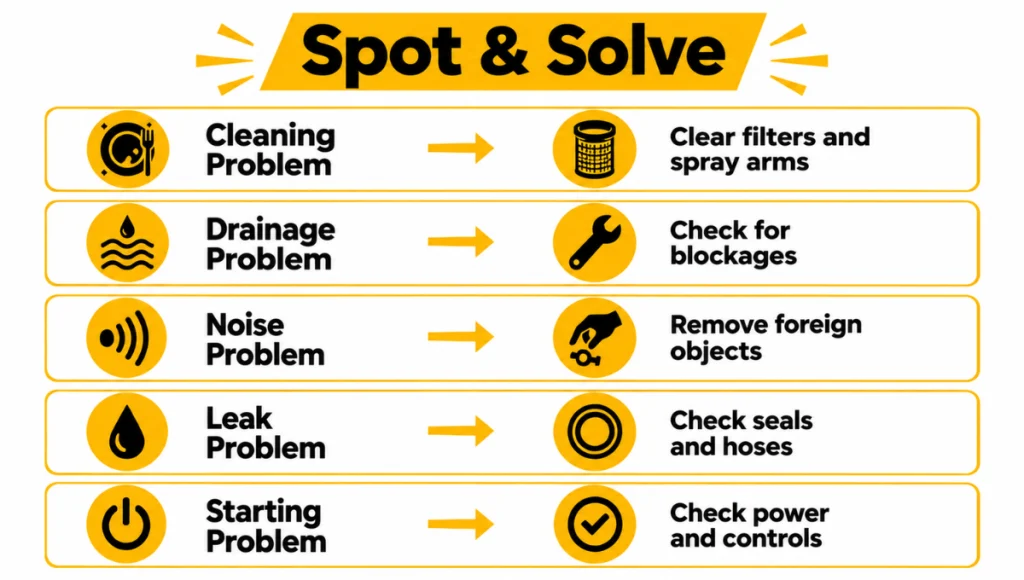
Despite proper maintenance of these appliances, some problems may occur occasionally with them. In order to understand whether the problems can be resolved, we have to find out their most frequent causes.
Dishwasher Not Cleaning Properly? Here’s Why
This can happen because of clogged filters, clogged holes on the spray arm, and the usage of low quantities of detergents. See whether you have any clogged filters or spray arms and whether water is heated properly for cleaning.
Water Not Draining Properly
If water collects at the bottom of the tub, a clogged filter, a blocked drain hose, or food particles trapped in the drain valve are likely the cause. Clean the filter and check that the drain hose isn’t kinked to fix this problem. If the issue persists, it is possible that there is a more serious issue with the plumbing system; our plumbing fixture installation guide can help you verify the connection.
Strange or Unusual Noises During a Cycle
A foreign object inside the spray arm or pump usually produces these grinding and buzzing sounds. A rattling sound happens when a dish shifts inside the tub or when the spray arm hits something as it rotates.
Dishwasher Leaking
Some of the causes that can lead to the leakage can be a faulty door seal, too much detergent in the detergent dispenser and loose connection of the drain hose. To diagnose the leak, check the gasket seal on the dishwasher door for cracks and make sure the dishwasher is level.
Appliance Won’t Start
If the dishwasher won’t start, check whether the door is closed, the control isn’t locked, and the appliance is receiving power. There could be an issue with the electricity if the dishwasher fails to start.
| Common Dishwasher Issue | Possible Cause | Recommended Action |
| Not cleaning properly | Filter clog or spray arm blockage | Clean the filters and spray arm nozzles |
| Not draining | Drain hose or filter blocked | Unscrew the filter to check whether the hose is bent. |
| Strange noises | Object trapped in the spray arm or pump | Observe and clear blockage. |
| Leaking | Loose-fitting door seal or hose | Make sure that it is level in there. |
| Not starting | Door unlocked or electricity problem | Verify the lock, lock control, and power source. |
When to Consult a Professional
However, there are times when it will be more practical to reach out to the professionals for assistance, especially when the issues involve any of the following – electrical components, plumbing components, or the inside parts of the appliance.
Dishwasher Repair Services
If troubleshooting does not provide a solution to the problem or if there are indications that the issue involves electricity, leaking, or the motor of the dishwasher, then it is recommended to seek professional assistance from dishwasher repair services.
Dishwasher Installation
For installing the dishwasher in a proper way, it is important to attach the dishwasher properly to the water supply, drainage, and electricity systems. For more information on how to perform this task, see the following article: Dishwasher Installation Guide.
Installation of Built-In Dishwashers
Concerning a built-in dishwasher, it is important to put it right into the existing furniture to keep it at the right level and right connection. Due to additional problems with built-in dishwashers, it is better to use the services of professionals when installing such appliances.
Dishwasher Maintenance Checklist
With a simple maintenance regime, your dishwasher will stay clean, nice-smelling and working effectively. Small actions will help avoid the clogging of your dishwasher and possible faults in it.
- Every day: Remove food remnants from the bottom, wipe the rubber sealing strip around the door and leave the door open for ventilation.
- Once a week: Check the filter and the rotating arms and the draining place.
- Once a month: Wash your appliance with the help of vinegar or cleaning tablets and check the door seals.
- Occasionally: Use the dishwasher cleaning product like Finish.
Why Choose Prohandymannow for Dishwasher Repair Services?

If your troubleshooting doesn’t work, or you notice electrical issues, leaks, strange motor noises, or need a new dishwasher installed, call in the experts—these situations require electrical and plumbing skills.
Although you follow an efficient routine of maintaining your dish washer, sometimes you may need professional help in repairing it. ProHandyMan provides professional dish washer services for those people who need everything in one go:
- Maintenance and cleaning services – for tuning up your dishwasher and ensuring its proper working.
- Repair services – we provide all necessary diagnosis and repairs which require more than simple troubleshooting.
- Installation services – both new dishwashers and built-in dishwasher installation.
Whatever you need, we will help you with it!
Conclusion
The regular cleaning of the dishwasher, checking the filter once a week and cleaning the appliance once a month will highly enhance its efficiency and avoid the need for expensive repair services in the future. The information on how to clean the filters, spray arms, door seals and choosing the right dishwasher detergent will be the answer to all the issues connected with unpleasant smells, clogged drainages and inefficiency of the dishwasher. Right maintenance of even minor issues such as clogs and leaks will prevent you from spending money on the repairs. In case you are unable to solve the problem or need to mount the dishwasher, it is better to contact the professional. Still facing issues with your dishwasher? Contact us today, and our team will take care of the repair or installation for you.
FAQs
How often should you clean your dishwasher?
A general cleaning, including wiping the door seals and checking the filter, should happen weekly. A deeper clean using vinegar or a dishwasher cleaning tablet is typically recommended every one to two months, depending on usage and water hardness in your area
How often should you clean the dishwasher filter?
The filter should be checked and rinsed every one to two weeks. Households that run the dishwasher daily or wash dishes with heavier food residue may benefit from checking it slightly more often to prevent buildup.
Can you use vinegar to clean a dishwasher?
Yes, white vinegar is commonly used to deep clean a dishwasher by placing it in a bowl on the top rack and running a hot, empty cycle. Avoid mixing vinegar with bleach or other cleaning chemicals, and always follow your dishwasher's manufacturer guidelines.
continue reading
Related Posts

Even small changes matter to make your space noticeable. Light